
Yoga and wellness retreats can be run across Albania and Montenegro from around EUR 1,800 per person, with fifteen days as the optimal length and groups of eight to twenty. InAlb works as the ground partner for the teacher, handling venues, accommodation, transport, meals and permits, so the retreat leader only has to teach.
- Fifteen days is the sweet spot for a retreat here. Ten is the floor and anything in between works.
- Group size runs from eight to twenty. Above twenty the leader ends up being a tour leader as well as the instructor.
- Ground cost starts at EUR 1,800 per person for 2027 and reaches about EUR 2,500 depending on hotel selection.
- Four kinds of practice space: empty beaches, mountain plateaus, open-air thermal pools and cool stone interiors for August.
- The best windows are late May to June and September to early October.
- Boats run to the Blue Cave from 1 April to early October.
Yoga teachers, pilates and breathwork instructors, personal trainers, wellness coaches and retreat organisers planning their own retreat in the Balkans, whether it is their first or their fifteenth.
Groups wanting a purpose-built retreat centre with a permanent shala, a resident chef and an on-site spa, because Albania is not there yet. Groups needing step-free access throughout, since thermal pools, stone cities and mountain guesthouses all mean uneven ground. Anyone set on the coast in the first two weeks of August, when the quiet that makes these places worth coming for disappears.
InAlb is a boutique tour operator, DMC and trip designer based in Tirana. Designing experiences is the whole job here, not a service bolted onto a booking engine. We are a Travelife Partner and top-ranked on Travelstride and the other platforms that let travellers rate the people who actually run their trip.
We work as the ground partner for teachers and coaches running their own retreats. You bring the practice and the people. We build the rest of it around you.
Here is the promise. It is the one that matters to you. Your group is not judging Albania when they get home. They are judging you. The place you chose, the mornings you gave them, the meal they still talk about in March. We plan every retreat with that in mind, because your reputation is the thing riding on it and we would rather protect it than sell you a package.
Can you run a yoga or wellness retreat in Albania?
Yes. It is one of the last places in southern Europe where you can hold a silent morning practice on an empty beach in September, soak your group in open-air thermal pools by a river the same week and still come in below what Portugal or Greece would cost. The spaces, the food and the quiet are all here. What is missing is a mature retreat industry, which is exactly why you want a local operator rather than a booking platform.
How many days do you need?
Fifteen is the sweet spot. Anything from ten to fifteen works and we will not quote under ten. Albania and Montenegro look small on a map and move slowly on the ground, so a retreat that takes in the coast, the mountains and the thermal springs in seven days turns into a coach tour with a class attached. Ten days buys you three bases with practice mornings no transfer interrupts. Fifteen buys you the same three bases with no early starts at all.
If your group only has a week, we will build a single-base retreat rather than compress the route. That is a better week.
How big should the group be?
Eight to twenty. Eight is where the economics start working and twenty is where it still feels like a retreat. Above twenty is completely manageable for us, but be honest with yourself first, because at that size you stop being only the instructor and start being a tour leader as well. Bigger groups also bring the per-person price down, so there is a real trade between your margin and how the trip feels.
The places and what you can actually run in them
This is the part most operators skip. Below is what each place is really like at the hour you would be using it.
Ksamil and the far south coast
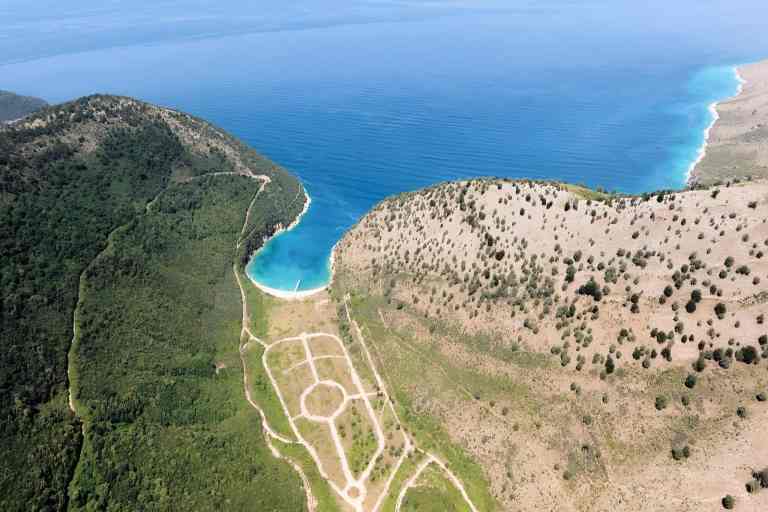
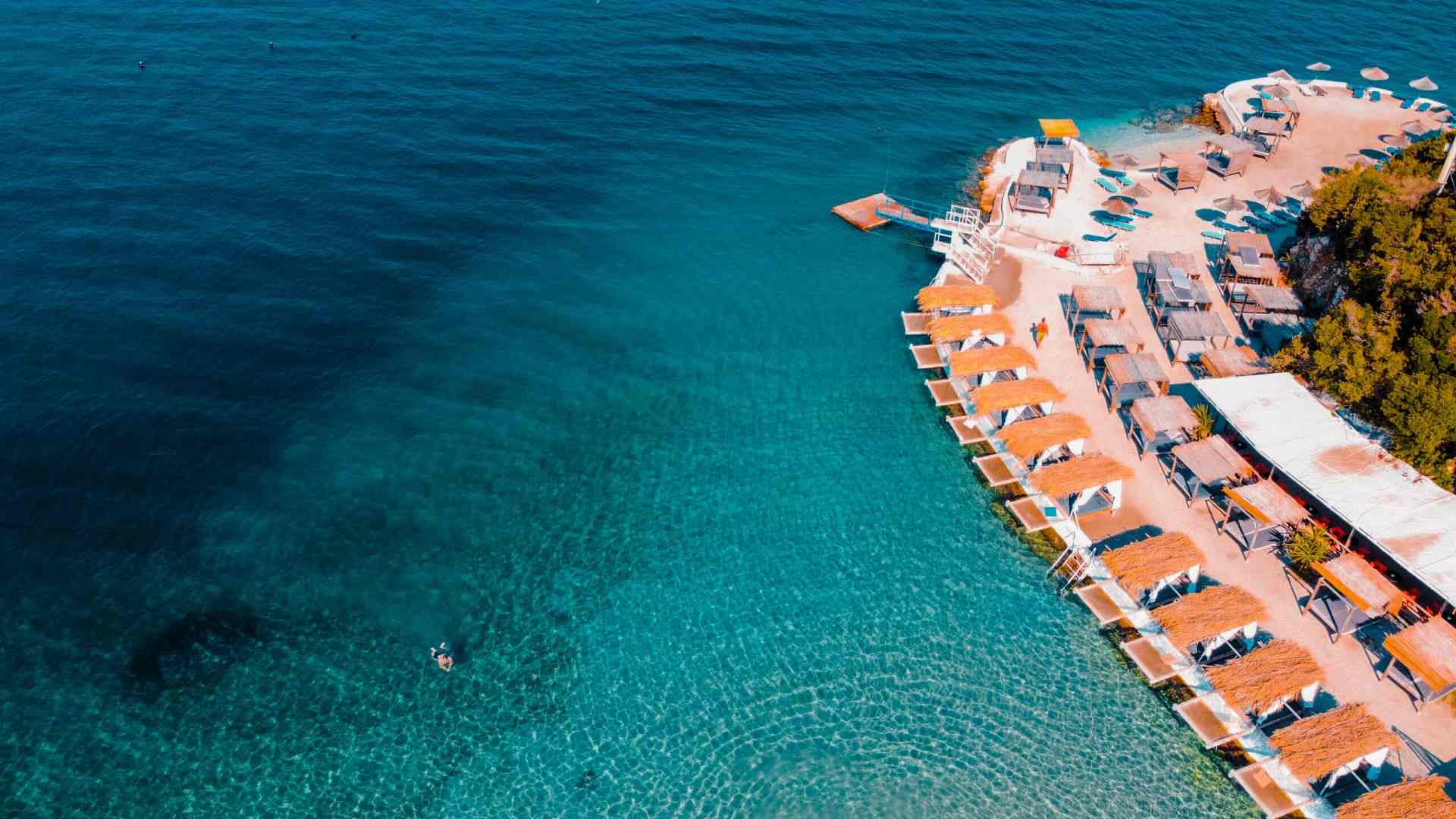
Four small islands sit a short swim off the beach at Ksamil, in water that goes turquoise over white sand and stays shallow a long way out. By eleven in the morning in July the beach clubs have taken it. At six, it is yours. We have run sunrise practice on that sand with nobody else on it and the only sound the water. Twenty minutes inland, Butrint sits in a lagoon with Greek, Roman, Byzantine and Venetian layers stacked in the same forest, a Roman theatre that still holds sound and a wetland full of birds. It is a good place to walk a group in silence before breakfast.
What runs here: beach practice at first light, sea swims, restorative sessions in the shade after lunch, a slow Butrint walk as an optional afternoon.

The Blue Eye at Muzinë
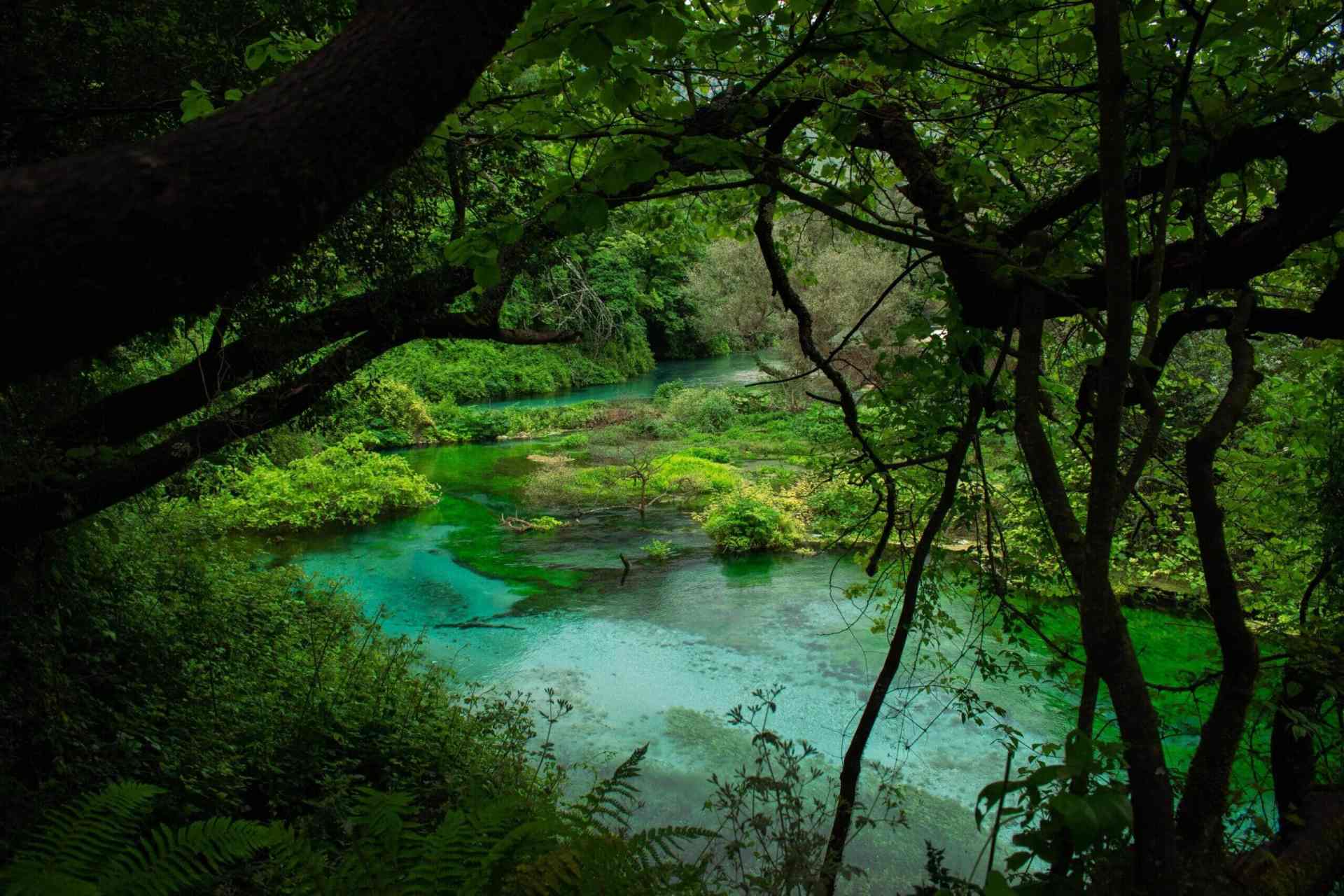
A karst spring that pushes water up from a depth nobody has properly reached, so cold it takes your breath and so clear that the centre reads as a dark blue pupil in a ring of green. It is a fifteen minute walk in from the road through oak woods. Groups go quiet when they see it, which is not something you can manufacture.
Treat it as a short, high-impact stop rather than a practice location. Access and swimming rules have changed more than once, so we confirm the current position before we put it in a programme.
What runs here: cold exposure and breathwork for groups that want it, standing meditation on the platforms, a genuinely memorable half-hour.
The Blue Cave on the Himara coast
You reach it by small boat from Himara or Dhërmi, along a coastline of white cliffs dropping straight into water, past coves with no road to them. The cave entrance is low enough that the boat slows right down and inside the light comes up through the water and turns the whole chamber a blue that does not look real. Boats time their entries so you are not sharing it.
Boats run to the cave from 1 April to early October. Sea state decides the rest, so we build it as a flexible morning rather than a fixed one.
What runs here: a boat morning that doubles as the group’s fun day, plus swimming in the coves on the way back. It is the day people post about.

Gjirokastra
A whole city built in grey stone, roofs of slate laid like fish scales, running up a hillside under a castle that has been there since the twelfth century. The Ottoman tower houses have rooms designed for heat, so their interiors stay cool and still in August when the coast is at thirty-five degrees. The old bazaar lanes are steep and cobbled and the light in the late afternoon comes across the Drino valley and turns the stone gold.
What runs here: indoor sessions in cool stone rooms, a walking half-day through the bazaar and up to the castle, dinner with qifqi and the local wine.

Bënjë thermal pools near Përmet
Stone pools of warm sulphurous water sitting right beside the Lengarica river, under an Ottoman bridge, with a canyon opening upstream. You climb from a hot pool into cold running river water and back again, which is a full contrast therapy circuit that nobody had to build. It is public and it fills up from mid-morning, so the trick is to be there at seven with the steam still coming off it.
Përmet itself is a quiet river town known for gliko, fruit preserved in syrup and for growing most of what it eats.
What runs here: the recovery day. Hot and cold rounds, a slow afternoon and the session where the group finally drops into the trip.

Theth and the Accursed Mountains
You get there over the Qafa e Thorës pass and the road is part of it. The valley opens out under limestone walls with a scatter of stone tower houses, a small stone-roofed church in a meadow and the Grunas waterfall running down the far side. Further up the valley there is a second Blue Eye, colder and wilder than the southern one, at the end of a proper hike. Mornings here are cold even in July and the silence is total.
The road is generally open from late spring to October. Snow closes the pass in winter.
What runs here: mountain practice at altitude, hiking days, evening sessions indoors with the wood stove going. This is where retreats get their photographs and their quiet.

Durmitor, Montenegro
Over the border and up onto a plateau at around fifteen hundred metres, where black pine forest surrounds a glacial lake and the Tara canyon cuts thirteen hundred metres down through the rock behind it, the deepest in Europe. The air is different up here. Mornings are cold and clean, the meadows go to wildflowers in June and by mid-morning the light on the water is flat and hard.
What runs here: practice on the lakeshore before anyone else is up, long walks, altitude that makes a group sleep properly for the first time all trip.

Kotor and the bay
A medieval walled town wedged between a mountain and a bay so steep-sided it reads as a fjord. Above the town, 1,350 steps climb the old fortifications to the fortress, which is the single best sunrise walk on this whole route if your group is up for it. Out on the water near Perast there is a small church on a man-made island, reachable in a few minutes by boat.
Kotor takes cruise ships. Before nine and after six, the old town belongs to whoever is in it.
What runs here: the sunrise walk up the walls, waterside practice on the quiet side of the bay and the group’s best dinner.

Budva
Livelier than Kotor, with a compact walled old town on a headland and beaches either side. It is the right place to finish rather than to practise, because it has energy the rest of the route deliberately does not. Some leaders want that as a closing night. Others want to skip it entirely and we build both.
What runs here: the last night, if your group is the kind that wants one.

What kinds of practice space are there?
| Setting | Where | Best window | Watch for |
|---|---|---|---|
| Beach | Ksamil, the coves near Himara and Dhërmi | First light and late afternoon | July and August are hot and busy from mid-morning |
| Mountain | Theth and the Accursed Mountains, Durmitor | Early morning, all day in high summer | Slow roads. Use these as bases, not day trips |
| Thermal water | Bënjë and the older sulphur baths at Elbasan | Before nine, before it fills | Bënjë is public. Nobody can hold it for you |
| Stone interiors | Gjirokastra, Berat | Any time and a relief in August | Ceiling heights and floors vary. We measure and photograph every room before offering it |
Why combine Albania with Montenegro?
Because the two countries share a lake and a fast border and because they give you two completely different retreat environments inside one route. Lake Skadar sits across the frontier between them, so you move from Shkodra into Montenegro without losing a day to driving. Coast, then mountains, then bay is an arc. A loop back on itself is not.
What the route looks like at ten days and what fifteen adds
Not an itinerary, a shape. We build the real one around your practice.
At ten days. Days 1 to 3 in the far south based near Ksamil, with Butrint, the Blue Eye and the sea. Days 4 and 5 inland to Gjirokastra and up to Bënjë for the recovery day. Days 6 and 7 north to Theth for altitude and silence. Days 8 to 10 across into Montenegro for Durmitor or the bay at Kotor. Three bases, three environments and no day with more than about three hours in a vehicle.
What the extra five days buy. Not more places. More mornings. At fifteen days every base gets a full spare day, which means the boat morning to the Blue Cave can move if the sea is up, the Theth hike is not squeezed against a transfer and Montenegro becomes a proper leg rather than a finish, so you can hold both Durmitor and the bay at Kotor instead of choosing. It also removes every early start. That is why we call fifteen the sweet spot rather than the upsell.
Should you add culture, food and activities or keep it pure practice?
Add them. The retreats that get rebooked are the ones where the group also ate somewhere they still talk about, met someone local and did one thing that was purely fun. A morning practice, a long lunch at a family farm and an optional afternoon beats three sessions.
We usually suggest one cultural half-day per base and we make it optional so nobody feels dragged off their mat. A cooking session in a family home. The bazaar in Gjirokastra. A boat morning on the Riviera. Gliko and wine in Përmet.
What do we handle and what do you handle?
You handle the practice, the teaching schedule, your marketing and your relationship with your group. That is your product and we do not touch it.
We handle the ground: accommodation at every base, private transport with our own vehicles and drivers, all meals and dietary requirements, practice spaces including an indoor backup at each base, permits where a site needs one, the cultural and activity add-ons, border logistics into Montenegro and a coordinator who is reachable for the whole retreat. We photograph and measure every indoor practice room before we offer it to you.
What does it cost?
For 2027, the ground cost starts at EUR 1,800 per person and runs to about EUR 2,500 per person at the top of the range. The variable is hotel selection, not the route. That covers accommodation at every base, private transport with our own vehicles and drivers, all meals, the practice spaces including an indoor backup at each base, activities and the coordinator.
Group size moves the number too. Twenty people pay noticeably less per head than eight on the same route, so it is worth telling us your realistic minimum rather than your hopeful one when you ask for a quote.
Your teaching fee sits on top of that and is yours to set.
Why plan it with InAlb
We are based in Tirana, we run these routes ourselves and we do not subcontract the parts that decide whether a retreat works. Your coordinator is someone you will have spoken to before you land. We visit and photograph every practice space before we offer it. And because Albania and Montenegro are where we work every week rather than a destination we resell, we can tell you which beach at Ksamil is empty at seven in the morning in the second week of September and whether the Bënjë pools will be quiet on a Tuesday.
That is the level of detail a retreat lives or dies on. It is also why we do this better than anyone in the Balkans, since it is the only region we work in.
The credentials, briefly, because you are trusting us with your group and your name. InAlb is a licensed Albanian tour operator and DMC and a Travelife Partner, which is an audited sustainability standard rather than a logo you buy. We are top-ranked on Travelstride and rated highly across the platforms where travellers score the operator who actually ran the trip, not the reseller who took the booking. Designing tours and experiences is what we do all day, every week of the season.
So bring your people. Give them a sunrise on an empty beach at Ksamil, an afternoon in a river canyon nobody in their yoga class has heard of and a dinner they will still be describing at Christmas. We will make sure the only thing they remember about the logistics is that there weren’t any.
Tell us your dates, your group size and what your practice needs and we will come back with a route and an exact price. Fifteen days, eight to twenty people, from EUR 1,800 per person for 2027.
info@inalb.al or +355 69 386 4912.
In our field experience the mistake first-time retreat leaders make is booking a beautiful hotel and assuming the practice space will work. We have walked into rooms with 2.2 metre ceilings, tiled floors and a pillar in the middle of them, so now we measure and photograph every room before anyone signs anything. The second mistake is the schedule. A group that has flown in and then driven three hours does not want a full practice at seven the next morning, so we build the first full day soft. Every teacher who has run a retreat before nods when we say that.
Common questions
When is the best time to run a retreat in Albania?
Late May to June and September to early October. The sea is warm enough to swim, the mountain roads are open, the coast is calm and the temperature suits outdoor practice. July and August work if the retreat is mountain-based, because Theth and Durmitor stay cool while the coast does not.
How long should a retreat in Albania and Montenegro be?
Fifteen days is the sweet spot and ten is the floor. Between those two it is a question of how many spare mornings you want. Under ten days we will build a single-base retreat instead of a route.
How big can a retreat group be?
Eight minimum and twenty maximum as standard. We can run larger and it is manageable, but past twenty the leader ends up doing a tour leader's job alongside teaching, which most instructors do not enjoy. Larger groups do lower the per-person price.
How much does a retreat in Albania cost per person?
For 2027 the ground cost starts at EUR 1,800 per person and reaches about EUR 2,500 at the top of the range, with hotel selection as the main variable. That covers accommodation, private transport, all meals, practice spaces and the coordinator. The teaching fee sits on top and is set by the retreat leader.
Can you hold the practice outdoors reliably?
In the shoulder seasons, most mornings. We always contract an indoor backup at every base, because one wet morning should not cost you a session.
Do you work from the teacher's itinerary or build it?
Either. Some teachers arrive with a full day-by-day plan and want us to make it possible. Others send a theme and a date range and we come back with a route. The second usually produces a better schedule, because we know which drives are longer than they look.
Can you handle dietary requirements?
Yes and it is easier here than most people expect. Albanian home cooking is vegetable-heavy by default. Vegan, gluten free and allergy needs are briefed to every kitchen in advance, not raised on arrival.
Can we swim at the Blue Eye at Muzine?
Access rules there have changed more than once, so we confirm the current position before it goes into a programme rather than promising it and disappointing a group.
Is InAlb licensed and insured?
Yes. InAlb is a licensed Albanian tour operator and DMC and a Travelife Partner, and we can supply documentation for your own insurer.
Want this arranged privately?
Send us your dates and we adjust this into a real trip.